Tag Archives: bald eagle

COOPERATIVE BREEDING

Cooperative breeding is a mystery that scientists have spent decades trying to unravel. It occurs among not only birds but also mammals, fish, and even insects. It is not necessarily a mating system per se, but has more to do with how adults care for their young.

Bald Eagle nest video cameras have provided an opportunity for viewers to observe and document 2 instances of cooperative breeding: on Catalina Island from 1992-2007, and near Lock & Dam 13 on the Mississippi River from 2014 through the present (winter 2018). Published literature includes 6 additional reports of cooperative breeding at Bald Eagle nests, in Alaska, Minnesota, Connecticut, New York, Texas, and British Columbia.

Through several pages on this site I attempt to make sense of some of the mysteries of cooperative breeding and explore the behavior among raptors, including descriptions of each of the known cases of cooperative breeding among Bald Eagles.

Click here to get started.

INTRASPECIFIC INTRUSIONS AT BALD EAGLE NESTS

© elfruler 2018

intraspecific adj. : occurring within a species or involving members of one species.” (www.merriam-webster.com)

Bald Eagles choose their breeding territories and nest sites carefully, driven by factors that will lead to success in raising their young.  These factors include adequate food resources, a sturdy nest platform, available shelter from dangerous weather, ease of defense, and tolerable distance from disturbances.  A good location will be attractive to any Bald Eagles that come along, and it is not surprising that a resident Bald Eagle pair will be challenged by other Bald Eagles for the site, leading to competition between members of the species, or intraspecific conflict.

It is not uncommon for one or both members of a pair to be challenged even before the nesting season begins, resulting in displacement, injury, and even death.  Conflicts that occur once a clutch of eggs has been laid or a brood of chicks has hatched can cause loss of eggs and chicks, despite the fierce defense that the parents inevitably mount against intruders.  Often the parents are successful in repelling a challenge and their chicks fledge.  In rare cases an intruder is accepted by the resident pair as a cooperative breeder (Go here for a series of pages about Cooperative Breeding and its occurrence among Bald Eagles).

The Bald Eagle nests that have been viewed on camera or monitored carefully from the ground since 1992 have provided a glimpse of intraspecific intrusions of many types and with a variety of outcomes:

  • Events before, during, and after the season
  • From one to many intruders
  • Intruding males and females, adults, subadults, and juveniles
  • Replacements, disappearances, injuries, and deaths of parents
  • Unhatched or broken eggs and injured or slain nestlings
  • Double clutches
  • Rescued nestlings and rehabbed fledglings
  • Successful fledges
  • Cooperative breeding

Even careful monitoring of cams and nests don’t provide the full picture of events surrounding intrusions, which often take place out of human view.  Even happenings in full view do not always have clear-cut explanations.

  • How many intruders are in the area?
  • When did they first appear?
  • What encounters occur off-nest between intruders and residents?
  • What is the sex or age of an intruder?
  • Does a resident eagle disappear because it has been injured or killed, or because it has decided that it cannot prevail in a battle?
  • Was an egg broken by an intruder or an agitated parent, or because it was unviable or infertile?
  • Did an egg fail to hatch because intruders interrupted the reproductive cycle and prevented fertilization?
  • Why would one intruder destroy eggs or chicks but another intruder leave eggs or chicks undamaged?
  • Does a resident adult respond primarily defensively to an intruder, or might there be a trigger that precipitates an offensive response?
  • Why would an intruder become a helper and cooperative breeder rather than a threat?

Answers to such questions would provide a much better understanding of events we can see, but too often the answers elude us.

The number of Bald Eagle nests for which reliable daily reports have been made more than doubled from 2008 to 2018 – from 24 to 57.  They range from southern California to New England, from south Florida to Alaska, and many points on the continent inbetween.  The nests are found in a variety of habitats, including rural farmland, along rivers and streams, lakes and bays, in woodlands in parks and wildlife refuges, on coastal islands, college campuses, and in city neighborhoods.  Yet it cannot be claimed that these nests are a representative sampling of all of the thousands of Bald Eagle nests in North America.

Nor can we be sure that we have witnessed every conceivable behavior or outcome associated with intraspecific intrusions.  The information that I present here is illustrative of certain types of Bald Eagle behavior, but should not be taken as a statistical report on intraspecific intrusions.

This first chart (at this link) describes the intraspecific intrusions observed at Bald Eagle nests from 1992 through 2018, the nest locations and habitats, what is known about the intruders, the events, and the outcomes.  (Link opens in a new browser tab.)  Losses (of parents, eggs, or chicks) can result directly or indirectly from intrusions, or they may occur for other reasons not related to intraspecific conflict.  Not every intrusion leads to a loss.

This second chart (follow this link) summarizes the details and gives percentages to enable comparison of intrusions, losses, and fledges from one year to the next.  (Link opens in a new browser tab.)  The percentages are number of intrusion events (nest intrusions, clutch intrusions, eggs lost, etc.) compared to the total number observed (nests, clutches, eggs., etc.) in that season.  (The years 1992-2007 at the California West End nest are not included in this summary because of the outsized effect of DDE contamination on egg production there.)  Notably, for these nests there is no clear trend in the percentages over time.

  • While 2018 clearly was a bad year for nest intrusions (including both before and during a clutch), at 24.6% of observed nests, 2008 was almost as bad, at 20.8% of observed nests.
  • On the other hand, 2008 was a worse year for clutch intrusions (after eggs were laid), at 19.2% compared to 17.9% in 2018.
  • And in 2008, 4.5% of chicks were lost, compared to a much smaller 1.3% in 2018.
  • The number of eggs lost was a staggering 11.3% in 2018, but the 8.6% of eggs lost in 2008 is the second highest percentage.
  • The year 2013 was difficult, with 13.6% of clutch intrusions and 6.7% of egg losses.
  • Some years were relatively benign: 2011 saw only one intrusion and 2012 only two.  A dip in losses occurred in 2015 and in intrusions in 2016.
  • From 2013-2017 most percentages were relatively stable – nest intrusions, clutch intrusions, losses – with an overall dip in 2016. Intrusions and losses in 2018 were severe, and it remains to be seen in coming seasons whether that year was an outlier.
BRIEF UPDATE ON THE 2018-2019 SEASON: I have not yet added new information to the charts, but the number of intraspecific intrusions declined significantly from the year before. Only 6 such intrusions occurred, only 2 of which happened after eggs were laid. 2 nests ended up with no eggs laid, and a total of 4 eggs were lost. No eaglets were lost.

There is no question that suitable habitat for nesting Bald Eagles is on the decline across the continent because of human development and encroachment.  But the numbers we have for these particular nests do not necessarily mean that increasing numbers of nest intrusions point to an approaching saturation of carrying capacity for Bald Eagles across the board.  Each territory has its own conditions that may or may not be either conducive or resistant to nest intrusions.  Increasing population density in a particular area may simply drive some Bald Eagles to adapt by seeking out previously unclaimed territories, by gradually shrinking the size of their territories (over time) to allow for more nests (if the food supply allows for it), or by allowing more instances of cooperative breeding.  It remains to be seen whether intraspecific intrusions will have a negative impact on the Bald Eagle population in the long run.  Some have argued that a rise in population density ultimately could result in a state of population equilibrium by slowing the breeding productivity to offset the long period of increase that followed the banning of DDT in 1972.

While the snapshots that these observed nests provide give us some narratives about intraspecific intrusions at Bald Eagle nests and make comparisons possible, a broader understanding of the causes and effects of such intrusions, as well as a glimpse of what they may entail in the future, must await more detailed and systematic studies (such as Mougeot et al. 2013 in Saskatchewan and Turrin and Watts in the Chesapeake Bay, 2014 and 2015).

For perspective on the Bald Eagle population in North America and trends over time, Partners in Flight (PIF) estimates the number of breeding-aged Bald Eagle individuals in 2017 at around 250,000, based on data from the North America Breeding Bird Survey, an approximate 131% increase since 1970.  The U.S. Fish & Wildlife Service’s oft-cited number of about 10,000 breeding pairs (or 20,000 individuals) in the lower 48 United States in 2007 does not include numbers from Canada or Alaska (both of which exceed the number in the lower 48 states), and it represents only eagles in pairs that are actively breeding.  The PIF estimate encompasses all individual Bald Eagles throughout North America of breeding age whether they have formed breeding pairs or not.  None of these numbers include juvenile or subadult Bald Eagles, which could more than double the totals.

 There is as yet no sign that the Bald Eagle population is declining, whether because of habitat changes that lead to overpopulation and intraspecific conflict in a territory, or other causes such as contaminants, trauma, electrocution, disease, poisoning, and poaching.  In 2010, following the removal of the Bald Eagle from the list of threatened and endangered species, the U.S. Fish & Wildlife Service produced a Post-delisting Monitoring Plan for the Bald Eagle.  The Plan establishes a 20-year monitoring period (roughly four generations of breeding Bald Eagles) in the lower 48 states, with data analyzed and reported to the public every 5 years.  The Plan will yield information on changes in numbers and their causes, and it includes provisions for responding to a 25% or greater decline with corrective action by federal, state, and local agencies, Native American Tribes, and other interested partners.  The Plan specifically references the possibility of re-listing the Bald Eagle as threatened and/or endangered as a remedy to an unacceptable level of decline.

REFERENCES

Dzus, E.H. and J.M. Gerrard 1993.  Factors influencing Bald Eagle densities in northcentral SaskatchewanThe Journal of Wildlife Management 57: 771-778.

Elliott, K.H, J.E. Elliott, L.K. Wilson, I. Jones, and K. Stenerson 2011.  Density-dependence in the survival and reproduction of Bald Eagles: linkages to chum salmonThe Journal of Wildlife Management 75: 1688-1699.

Farmer, C.J., L.J. Goodrich, E. Ruelas I., and J.P. Smith  2008.  Conservation Status of North America’s Birds of Prey.  In K.L. Bildstein, J.P. Smith, E. Ruelas I., and R.R. Veit (eds). State of North America’s Birds of Prey.  Nuttall Ornithological Club and American Ornithologists.  Union Series in Ornithology No. 3. Cambridge, Massachusetts, and Washington, D.C., 303-420.

Grubb, T.G., L.A. Forbis, M. McWhorter, and D.R. Sherman 1988.  Adaptive perch selection as a mechanism of adoption by a replacement Bald EagleThe Wilson Bulletin 100: 302-305.

Hancock Wildlife Foundation Forum.

Hornby Eagle Group Projects Society.  Our Nature Zone.

Hunt, W.G. 1998.  Raptor floaters at Moffat’s equilibriumOikos 82: 191-197.

Institute for Wildlife Studies.  Channel Islands EagleCAM Forum.

Jenkins, J.M. and R.E. Jackman 1993.  Mate and nest site fidelity in a resident population of Bald EaglesThe Condor 95: 1053-1056.

JudyB.  Watching Eaglets Grow.

Mahaffy, M.S. and L.D. Frenzel 1987.  Elicited territorial responses of northern Bald Eagles near active nestsThe Journal of Wildlife Management 51:551-554.

Markham, A.C. and B.D. Watts.  Documentation of infanticide and cannibalism in Bald EaglesJournal of Raptor Research 41: 41-44.

Mougeot, F. 2004.  Breeding density, cuckoldry risk and copulation behaviour during the fertile period in raptors: a comparative analysisAnimal Behaviour 76: 1067-1076.

Mougeot, F., J. Gerrard, E. Dzus, B. Arroyo, P.N. Gerrard, C. Dzus, and G. Bortolotti 2013.  Population trends and reproduction of Bald Eagles at Besnard Lake, Saskatchewan, Canada 1968-2012Journal of Raptor Research 47: 96-107.

Partners in Flight.

Turrin, C. and B.D. Watts 2014.  Intraspecific intrusion at Bald Eagle nestsArdea 102: 71-87.

Turrin, C. and B.D. Watts 2015.  Nest guarding in Chesapeake Bay Bald EaglesJournal of Raptor Research 49: 18-28.

U.S. Fish and Wildlife Service.

Watts, B.D., G.D. Therres, and M.A. Byrd 2007.  Status, distribution, and the future of Bald Eagles in the Chesapeake Bay areaWaterbirds 30: 25-38.

Watts, B.D., G.D. Therres, and M.A. Byrd 2008.  Recovery of the Chesapeake Bay Bald Eagle nesting populationThe Journal of Wildlife Management 72: 152-158.

HALIAEETUS LEUCOCEPHALUS

You know what it means.  (DO you know what it means?  The Latinized-Greekish universal scientific name for “Bald Eagle”?  Literally translated “Sea-Eagle White-Head”?  Term established in the 18th century by Swedish naturalist and taxonomist Carl Linnaeus?  Yes, you knew that.)

But can you say it out loud?  Without sneezing or coughing or mumbling?

I couldn’t either until I utilized the ever-handy Google to find someone to say it for me.

I found lots of someones.  Here’s a site that has Americans, Brits, Welsh, Australians, Canadians, Dutch, Chinese, Germans, Italians, Japanese, Poles, Danes, Russians, Spaniards, Turks, and yes, Swedes, and smart people of other nationalities saying it.

Go ahead.  Impress your friends.

MEASURING ADULT, SUBADULT, AND JUVENILE BALD EAGLES

©elfruler 2018

See MEASURING AN EAGLE for details on procedures and challenges of acquiring measurements and descriptions and figures of the features measured.   General References are given at this link, while References specific to each table below are given at the end of each table.

The charts below give measurements of adult and subadult Bald Eagles as reported in peer-reviewed publications.  I have omitted measurements that are questionable or not standard.  (If a reader knows of reports that I do not include here, please contact me with details.)

These numbers provide some context for consideration of several factors relating to size in Bald Eagles:

Age

The age of a Bald Eagle during its first five years affects several measurements.

  • Beak and talons increase in size.
    • A Bald Eagle’s beak and talons are not fully grown at fledge but increase slowly in size over approximately its first 3 years. This is probably caused by a gradual buildup of the keratin layer over the underlying bones (which do appear to be fully grown at fledge) (Bortolotti 1984d).
  • Feathers decrease in length.
    • A juvenile, a fledgling eagle in its 1st year, has longer flight feathers (wing and tail) than it will ever have again.
    • With each successive molt of a subadult from its 2nd year through its 5th, the new flight feathers are a few millimeters shorter.
    • After reaching maturity, feather lengths of adults remain steady. But feathers wear down over time:  An individual Bald Eagle primary or secondary feather molts only every 3-4 years so it becomes progressively shorter over that period.  Also, a new flight feather can take 40-50 days to grow to its full length, so a measurement before it has finished growing will be misleading.
  • Weight.
    • Primarily because of the decreasing feather lengths, an eagle’s weight decreases slightly over its 1st 5 years.
  • Researchers cannot always be certain of the age of a particular bird, and some offer vague or imprecise descriptions of age, such as “second winter,” “immature,” or “subadult.”
  • Only measurements of the same eagle from one year to the next would yield meaningful comparisons, and this is possible only with a captive bird or with nestlings that are visited more than once before they fledge. Few such measurements exist.

Sexual dimorphism

  • Females are larger than males in general, although exceptions can exist. The numbers tabulated here indicate that the difference can be from 13-23%, although some publications and internet sites claim as much as 25-30%.
  • Adult females are larger than subadult females.
  • Adult males are not significantly larger than younger males. (Bortolotti 1984c)

Geographical location and “Bergmann’s rule”

  • It has been stated often that the size of Bald Eagles increases from south to north, and the so-called “Bergmann’s rule” is cited as an explanation for this phenomenon. The numbers in my tables do not necessarily confirm this “rule” for Bald Eagles, as discussed below.
  • “Bergmann’s rule” has roots in an 1847 article by Carl Bergmann, entitled “On the relationship of the warmth economy of animals to their size” (trans. Salewski and Watt 2016).
    • Bergmann described a “law” pertaining to warm-blooded animals (birds and mammals):
      • Since larger animals have a smaller ratio of body surface area to body volume, they expend less effort than smaller animals to maintain a constant internal body temperature. (The surface area is important for the dissipation of heat from the body to compensate for excessive environmental heat, while the volume is pertinent to heat production to warm the body in excessive cold.)
    • From this “law,” Bergmann hypothesized that larger animals need a cooler climate than smaller animals. Since in general environmental temperature is lower at higher latitudes (further north), it follows that larger animals would favor northern environments and smaller animals would favor southern environments, a concept that biologists refer to as a latitudinal size cline, a gradation of size from larger to smaller, in this case from north to south.
    • Bergmann tested the size cline hypothesis by comparing the relative sizes of species within a genus, only once mentioning the sizes of individuals within a single species (the White-tailed Eagle, see below). Using wingspan (not body volume, or weight) to compare size, he examined 310 species across 86 genera and concluded that the hypothesis of a latitudinal size cline is true in most (but not all) cases.
    • To address the exceptions, Bergmann noted that other factors besides latitude might be in play:
      • Altitude (mountainous habitats generally are cooler than lower elevations).
      • The reliability of wingspan as an indicator of size (e.g. the Merlin has a smaller wingspan than the European Hobby but can be of comparable weight and remains in northern climates through the winter).
      • Migratory habits (which may affect wingspan).
      • Quality of plumage.
    • Bergmann included Bald Eagles (Haliaeetus leucocephalus) in a sea-eagle taxon with White-tailed Eagles (Haliaeetus albicilla), Short-toed Eagles, and Ospreys, although he acknowledged that in his day there was disagreement about whether they all belong in the same genus (taxonomists today agree that they do not).
      • He noted that among White-tailed Eagles, which conform to the hypothesis in general, some smaller individuals may be found in the north and some larger ones in the south.
    • Bergmann himself never articulated a “rule” about a relationship between the size of an animal and its geographical location. Later researchers have formulated the “rule” in different ways, and there remain disagreements about its underlying assumptions, its application, and even its validity.
    • A latitudinal size cline does not apply to all species and genera of birds. Meiri and Dayan 2003 surveyed studies of 94 species of birds that provide reliable data on size and locale and concluded that “over 72% of birds…follow Bergmann’s rule.”
      • Among raptors found in North America, that includes Turkey Vultures, Peregrine Falcons, Sharp-Shinned Hawks, and Ospreys.
      • But several North American raptors do not follow “Bergmann’s rule”: Cooper’s Hawks (Whaley and White 1994) , Northern Goshawks (Whaley and White 1994), Red-tailed Hawks (Fitzpatrick and Dunk 1999), and Merlins (Temple 1972).
      • Meiri and Dayan did not include Bald Eagles in their survey because not enough studies were available that provide “data that were statistically tested for geographic variation.”
    • My tables here do not provide such data for Bald Eagles either. The sampling in the published literature is too small, variable, and arbitrary to either confirm or refute “Bergmann’s rule” in the case of Bald Eagles.
    • In fact, the numbers I have tabulated suggest that, as with White-tailed Eagles, which are close genetic relatives of Bald Eagles, some smaller individual Bald Eagles may be found in the north and some larger ones in the south. The ranges of weight and wingspan measurements in my tables illustrate some exceptions to “Bergmann’s rule” (ranges are given in parentheses and italics below the averages):
      • The highest weight among females was recorded in Illinois (6577g) and the lowest in Saskatechwan (4540g) – higher in the south, lower in the north.
      • The highest weight among males was found in Alaska (5625g) and the lowest also in Alaska (3633g) – both high and low in the north.
      • The longest wingspan among females was recorded in Alaska (2333.5mm) and the shortest in Illinois (2035mm) – longer in the north, shorter in the south.
      • But the longest wingspan among males was found in Alaska (2171.7mm) and the shortest in Saskatchewan (2027mm) – both long and short in the north.
    • In conclusion, until more systematic studies of Bald Eagles are done with large samplings of measurements across a full range of geographic locations, we cannot be certain which of the following is true:
      • Bald Eagles are more similar to Turkey Vultures, Ospreys, Peregrine Falcons, and Sharp-Shinned Hawks in always or almost always conforming to “Bergmann’s rule,” or,
      • Bald Eagles are more similar to their sister White-tailed Eagles in following the “rule” generally, but having many individual exceptions. Our limited data suggests that this is a more accurate statement.

ADULT BALD EAGLE MEASUREMENTS TABLE

SUBADULT AND JUVENILE BALD EAGLE MEASUREMENTS TABLE

REFERENCES

MEASURING AN EAGLE: REFERENCES

Baird, S.F., T.M. Brewer, and R. Ridgway 1874.  A History of North American Birds: Volume III, Land Birds.  Little, Brown, and Co.: Boston.

Baldwin, S. P., H. C. Oberholser, and L.G. Worley 1931.  Measurements of Birds (1931).  Scientific Publications of the Cleveland Museum of Natural History, Cleveland, OH.

Bent, A.C. 1937.  Life histories of North American birds of prey: order falconiformes.  Smithsonian Institution, Washington, DC.

Bortolotti, G.R. 1984a.  Criteria for determining age and sex of nestling Bald EaglesJournal of Field Ornithology 55: 467-481.

Bortolotti, G.R. 1984c.  Sexual size dimorphism and age-related size variation in Bald Eagles.  The Journal of Wildlife Management 48: 72-81.

Bortolotti, G.R. 1984d.  Physical development of nestling Bald Eagles with emphasis on the timing of growth events.  The Wilson Bulletin 96: 524-542.

Broley, C.L. 1947.  Migration and nesting of Florida Bald Eagles.  The Wilson Bulletin. 59: 3-20.

Chura, N.J., and P.A. Stewart 1967.  Care, food consumption, and behavior of Bald Eagles used in DDT testsThe Wilson Bulletin. 79: 441-448.

Fitzpatrick, B.M. and J.R. Dunk 1999.  Ecogeographic variation in morphology of Red-Tailed hawks in western North America.  Journal of Raptor Research 33: 305-312.

Friedmann, H. 1950.  The birds of North and Middle America: A descriptive catalog.  Part XI.  Smithsonian Institution, Washington, D.C.

Gerrard, J.M. and G.R. Bortolotti 1988.  The Bald Eagles: Haunts and Habits of a Wilderness Monarch.  Smithsonian Institution Press, Washington and London.

Gerrard, J.M., A.R. Harmata, and P.N. Gerrard 1992.  Home range and activity of a pair of Bald Eagles breeding in northern Saskatchewan.  Journal of Raptor Research 26: 229-234.

Imler, R.H. and E.R. Kalmbach 1955.  The Bald Eagle and its economic status.  U.S. Fish and Wildlife Service Circular 30.

Maestrelli, J.R. and S.N. Wiemeyer 1975.  Breeding Bald Eagles in captivityThe Wilson Bulletin 87: 45-53.

Meiri, S. and T. Dayan 2003.  On the validity of Bergmann’s ruleJournal of Biogeography 30: 331-351.

Palmer, R.S., ed. 1988.  Handbook of North American Birds vol. 4: Family Cathartidae, New World condors and vultures; Family Accipitridae (first part), Osprey, kites, bald eagle and allies, accipiters, harrier, buteo allies.  Yale University Press, New Haven and London: 187-237.

Salewski, V. and C. Watt 2016.  Bergmann’s rule: a biophysiological rule examined in birdsOikos 126: 161-172.

Southern, W.E. 1964.  Additional observations on winter Bald Eagle populations: including remarks on biotelemetry techniques and immature plumagesThe Wilson Bulletin 64: 121-137.

Stalmaster, M.  The Bald Eagle.  Universe Books, New York.

Temple, S.A. 1972.  Systematics and evolution of the North American merlins.  Auk 89: 325-338.

U.S. Fish and Wildlife Service Forensic Laboratory.  The Feather Atlas: Flight feathers of North American birds.

Whaley, W.H. and C.M. White 1994.  Trends in geographic variation of Cooper’s hawk and Northern goshawk in Northern America: a multivariate analysis.  Proceedings of the Western Foundation of Vertebrate Zoology 5: 161-209.

Wright, B.S. 1953.  The relation of Bald Eagles to breeding ducks in New Brunswick.  The Journal of Wildlife Management 17: 55-62.

MEASURING AN EAGLE

©elfruler 2018

Acquiring accurate measurements of a bird is a tricky business, and it turns out that there are relatively few peer-reviewed publications that report measurements for Bald Eagles.  In the pages that follow I present tabulations of the credible numbers of which I am aware.  I begin with some general information on measurements and measuring.  General References are given at this link.

What are the sources of measurements?

The most reliable measurements are taken from a live, wild, healthy eagle, but capturing one is difficult and rarely attempted.  Some researchers have used captive eagles, recently deceased eagles, and museum specimens for measurements, but these present some issues that must be considered:

  • Permanently disabled eagles in captivity may have different measurements from those of their cousins in the wild because of richer diets, less exercise, irregular feather molt, abnormal beak length and depth (due to inconsistent feaking), etc.
  • A rescued eagle in distress is usually dehydrated and emaciated, so its weight is likely to be lower than normal. After being treated in rehab for days or weeks during recovery, its diet may be richer and more abundant than it would be had the eagle continued living in the wild, which coupled with a reduced level of activity may result in a higher weight than normal at its release.
  • A recently deceased eagle can yield accurate measurements unless the eagle succumbed to injury or starvation, or the body has decomposed or been disfigured by a predator.
  • Measurements of carcasses that have ended up as prepared skin specimens in museums or other collections can be useful for some features, such as talons, bill depth, wing length, and tail length. But a specimen is subject to drying and shrinkage which can affect some measurements such as total length, bill width, tarsus width, wing chord, wingspan, and individual feather length.  And since most bones are absent from prepared skins, weight and most skeletal measurements are impossible.  Specimens also can yield erroneous sex classifications, especially with younger birds.  (Bortolotti 1984c)

How do researchers measure?

  • Scales, calipers, and tape measures are standard tools.
    • Digital scales give more precise readings than analog scales. All scales should be well calibrated.
    • Methods for positioning the bird on scales and for a linear measurement can be surprisingly challenging and require study of best practices as well as training and practice.
  • Measurements are best reported in universally used metric units (grams, millimeters, etc.), although some earlier studies and a few recent ones use the “traditional” American system of pounds, ounces, feet, and inches.
    • For ease of comparison, here I use metric units including conversions where necessary.
  • For features that incorporate a curve or arc, such as the folded wing, talons, beak, and feathers, the measurement is of the chord, or a straight line between two end points, thus disregarding the curve. Measuring the curve itself requires a calculation based on the shape of the curve and may lead to only an approximate measurement that can make comparisons difficult.  Feathers and wings are not rigid and can be flattened to eliminate the curve, but this can introduce inconsistencies or inaccuracies and is generally avoided by researchers.
  • Reliable statistical analysis requires a sampling of a large enough number of birds to provide minimum, maximum, and average measurements. The notation “N=x,” where x is the number of birds examined, conveys the size of the sampling.  In general the average is the mean.  Some researchers calculate a standard deviation (SD).

What features do researchers measure?

P. Baldwin, H. C. Oberholser, and L.G. Worley, Measurements of Birds (1931) established a comprehensive and standardized system of obtaining linear measurements of the various parts of birds, which continues to guide researchers. It includes detailed discussion of procedures and challenges and the tools needed to obtain accurate and consistent measurements, along with drawings showing what to measure, how to position the bird, and where to place the tools.

  • Subsequent studies of raptors have offered nuances and modifications necessary for measuring these species.
  • The authors of some studies do not always make clear what exactly what they measured or what procedures they followed, or their procedures may not conform to standard practices. For example, some authors do not indicate whether they used live birds or specimens, they may omit important information on the geographical origins, age, or sex of the birds, or they may use unorthodox techniques without explanation.

The following measurements of Bald Eagles have been reported in published literature.  (Figures from Baldwin et al. 1931 are used under the license agreement with Creative Commons.  Figures from Bortolotti 1984a are used with permission of The Journal of Field Ornithology.  Figures from Bortolotti 1984c are used with permission of The Wildlife Society, Bethesda, MD.)

  • Weight, which would seem to be a straightforward measurement to obtain simply by putting the bird on a scale.  But several factors can skew the reading, and researchers do not always indicate whether they have addressed them:
    • A malnourished or otherwise unhealthy bird.
    • Contents of the stomach and crop, which can vary widely from hour to hour or day to day (according to Gerrard & Bortolotti 1988, a Bald Eagle’s crop can hold about 15% of its body weight). A desirable reading would be a “net” weight with empty stomach and crop.
    • Time of year the bird is weighed, as for instance for females in the lead up to egg-laying when they can gain weight and afterwards when they can lose weight, or around migration or dispersal season which could begin with weight gain and end with weight loss.
    • Recently deceased birds can give an accurate weight, but specimens will not.
  • Length of the bird from the tip of the beak to the tip of the tail.  This measurement is taken with the bird lying flat on its back, its head and tail stretched as flat against the table surface as possible (Figure 1 © Baldwin et al. 1931 as licensed by Creative Commons).
    • This is not the “height” of the bird, which on many internet sites seems to mean a measurement from the crown of the head to either the tip of the tail or the bottom of the feet while the bird is perched or standing. This “height” usually is stated as being about 3 feet for a Bald Eagle, although the method of measuring this is rarely specified.
    • This measurement can be difficult to obtain with a high degree of accuracy because of variability in stretching the neck.  Skin specimens will not give an accurate measurement.
    • There are few reported measurements of a Bald Eagle’s length in the ornithological literature.
  • Depth of the beak, from the maxilla at the front (anterior) edge of the cere to the opposite point on the lower mandible (© Bortolotti 1984c, Fig. 1c, used by permission).
    • See the measurement at C.
    • The exact place at which this measurement is taken can result in significant variation in the measurement and thus can be unreliable for comparison purposes.
      • Specimens can provide accurate readings unless the carcass was dried with the beak open.


  • Width of the beak, the widest point where the cere meets the feathers (Figure 13 © Baldwin et al. 1931 as licensed by Creative Commons).
    • The exact point at which this measurement is taken can cause significant variation in the reading and thus is not always reliable for comparison purposes.
    • Specimens provide less reliable readings.
  • Length of the exposed culmen of the beak, the chord of the beak from the tip of the culmen (the curve on the top of the upper mandible) to the front (anterior) edge of the cere, thus the length of the culmen without cere (see above, Bortolotti 1984c, Fig. 1a).
    • Specimens can provide reliable readings.
    • Some researchers measure the culmen with cere, i.e. to the back (posterior) edge of the cere where the feathers begin, although they do not always say so; these are not included here.
  • Length of the beak from the gape, a straight line (chord) from the tip of the upper mandible to the gape or corner of the mouth.
    • Specimens provide less reliable readings (see above, Bortolotti 1984c Fig. 1b).
  • Length of the foot, or foot pad, the bottom of the foot from the end of the middle toe to the end of the hallux toe, with both toes fully extended and not including the talons (© Bortolotti 1984a, Fig. 1, used by permission).
    • Taking this measurement on a live bird can be challenging unless the bird is anesthetized and thus relaxed.  Specimens usually will not yield accurate results unless the toes were extended during preparation before the skin dries out.
  • Tarsus or tarsometatarsus, the “foot” or lowest part of the leg, from which two measurements can be made:
    • Length, from the intratarsal joint where the ankle meets the heel to just above the base of the middle toe below the lowest scute (scale) on the leg. This measurement is a long diagonal from the intratarsal joint at the back of the leg to the base of the toe at the front of the foot.  Reports of this measurement can vary, perhaps because of imprecision of identifying the end points.  (Figure 136 (© Baldwin et al. 1931 as licensed by Creative Commons).
    • Width, which Baldwin et al. 1931 prescribe should be taken at the midpoint of the tarsus. The tarsus is wider when measured from front to back and narrower when measured from one side to the other; generally the front-to-back diameter of the tarsus is measured (Fig. 137 © Baldwin et al. 1931 as licensed by Creative Commons).   But the few reported measurements for Bald Eagles are taken just above the toes at the narrowest point of the tarsus, and calculations are of an average of two measurements taken front-to-back and side-to-side, yielding mean width rather than diameter.  Either way, width is a highly variable measurement in reports, and specimens do not always yield reliable readings (Bortolotti 1984a and Bortolotti 1984c).
  • Middle toe (the 3rd and longest digit), measured from above, from its base at the metatarsal joint outward to the end of the toe, not including the talon (Fig. 139 © Baldwin et al. 1931 as licensed by Creative Commons).The toe must be extended as straight as possible.
  • Length of the hallux talon, the chord from the talon’s tip to the point on top where it emerges from the skin of the toe. (see above, Bortolotti 1984c, Fig. 1d).
      • Specimens can provide reliable readings.
  • Length of a feather, the chord of the shaft from where it enters the skin to its tip, without flattening the shaft (Fig. 114 © Baldwin et al. 1931 as licensed by Creative Commons).
      • For Bald Eagles this is usually done only on flight feathers.
      • See these photos of Bald Eagle primaries and secondaries from the U.S.F.W.S. Feather Atlas.
  • Tail, the longest point from the bases of the feathers at the skin to the tips, measured with the tail closed, the ruler placed between the two innermost, or central rectrix, feathers (Fig. 120 © Baldwin et al. 1931 as licensed by Creative Commons).
      • Specimens can give reliable readings of this measurement.
  • Wing chord, the length of the closed, unflattened wing from the wrist joint to the feather tips (Fig. 101 © Baldwin et al. 1931 as licensed by Creative Commons).
    • Some reported Bald Eagle measurements appear to have been taken with flattened wings, hence are longer than measurements of the chord; these are not included here.
    • Specimens may not give reliable measurements.
  • Wingspan, between the tips of the outstretched wings with feathers, measured with the bird lying flat on its back (Fig. 98 © Baldwin et al. 1931 as licensed by Creative Commons).
    • Attempts to measure while the bird is standing or perched are less reliable and consistent.
    • Care must be taken not to injure the wings by over-stretching or flattening them.
    • Specimens will not give accurate readings.
    • There are surprisingly few Bald Eagle wingspan measurements reported in the literature.

MEASURING ADULT, SUBADULT, AND JUVENILE BALD EAGLES

ADULT BALD EAGLE MEASUREMENTS TABLE

SUBADULT AND JUVENILE BALD EAGLE MEASUREMENTS TABLE

REFERENCES

HATCHING!

You know about the internal pip, the egg tooth, and the external pip. But do you know about symmetrical hatching, the complexus muscle, gas exchange via the chorioallantoic membrane, nidicolous chicks, and semialtricial species? If you’re interested in a slightly different presentation of hatching, check this out.

HATCHING

© elfruler 2018, 2026
with thanks to Donna Young

(Click on images for an enlarged view; on videos, click on full screen icon. )

The avian egg is a marvel of nature, a self-enclosed and perfectly effective living environment for the developing bird embryo. It contains all that is necessary to enable a small and weak organism to develop into a chick with all its parts and enough strength to break through and emerge into the outside world. Here is an account of the many factors involved in a chick’s hatching.

Inside the shell

  • The eggshell is a complex structure of hard calcium carbonate crystals interwoven with collagen fibers, and it is coated by a thin layer of crystalline calcite and smooth protein cuticle. The shell is sturdy enough to protect the developing embryo, yet it has microscopic pores that allow oxygen to pass into the egg and carbon dioxide and water vapors to pass out.
  • Two soft keratin membranes line the inside of the shell, both formed in the isthmus of the oviduct to serve as developmental and structural foundation for the hard shell. These shell membranes help protect the embryo from external microbes, facilitate the exchange of oxygen, carbon dioxide, water between the embryo and the outside environment, and collect calcium from the shell to be transferred to the embryo for its bone development. The outer membrane is attached to the inside of the shell, and the thinner inner membrane lines the outer membrane. There is a small gap between the 2 membranes in the blunt end of the shell.
  • The yolk sac, with its supply of fats and proteins to nourish the growing embryo, is attached to the embryo by a cord leading into the abdominal cavity.
  • Another membrane is adjacent to the inner shell membrane, the chorioallantoic membrane (CAM). It surrounds the embryo and the yolk sac and is connected to the embryo’s heart via blood capillaries that pass through the abdominal wall at the same opening where the yolk sac enters. The CAM performs the embryo’s respiratory function, transferring oxygen received by the shell membranes to the embryo and sending carbon dioxide out through the shell membranes. It also transfers calcium from the shell to the embryo, and collects wastes and stores them until after hatch. At hatch the CAM remains attached to the shell and detaches from the chick.
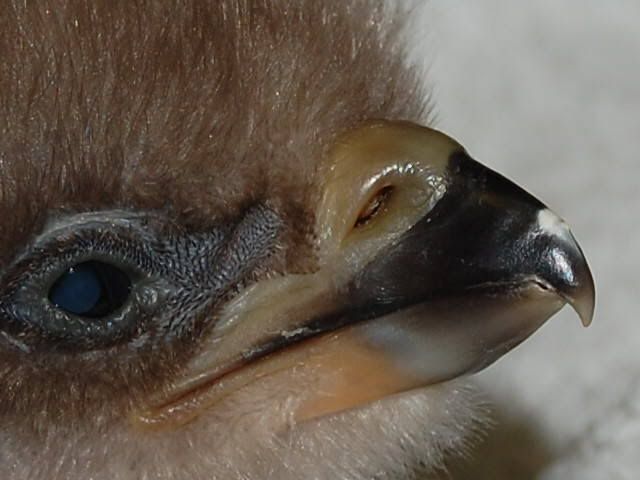
  • Starting about a third of the way through the ~36 days of an eagle embryo’s growth in the egg, an “egg tooth” or “pipping tooth,” a small, hard, sharp protuberance of calcified keratin near the tip of the beak’s upper mandible, begins to develop. Click here for a closeup of the egg tooth on a hatchling eaglet at the Institute for Wildlife Studies. The egg tooth gradually wears away within a couple of weeks after hatch.
  • A few days before hatch begins, a paired muscle in the back of the chick’s neck (the complexus or hatching muscle) swells in response to the influx of fluids from adjacent lymph glands. (This muscle plays a role in neck extension in grown eagles).
  • Just before hatch, the egg weighs about three-quarters of its weight when it was laid, because it has absorbed and metabolized fats from the yolk and lost evaporated water through the membranes. When laid, a Bald Eagle weighs about 113-127 g (4-4.5 oz.). By the time it hatches the egg’s weight has been reduced to about 89-102 g (3.2-3.6 oz.). Sizes vary with latitude, larger in the north than in the south, and with hatch order – eggs decrease in size from the first egg of a clutch to the last. The eggshell is much thinner than when the egg was laid because the chick has absorbed much of its calcium for its bones.

The hatching process

  • As the embryo nears hatch it takes up most of the space inside the shell – it is crowded in there! The chick lies on its left side with its feet in the smaller end of the shell and its head tucked forward against its breast near the blunt end of the shell. The inner shell membrane and CAM are draped over the head, beak, and wings.

    © elfruler
  • In the days leading up to hatch, the evaporation of water leads to an increase in the amount of air inside the shell, which enlarges the gap between the inner and outer shell membranes at the blunt end. This expanded air cell spreads along the shell’s upper side. As it takes hatching position the embryo’s back is pressed against the air cell and its head is tucked forward towards its belly and under the right wing, with the beak pointing toward the air cell.

    Image used by permission courtesy of Charles County, MD, Dept. of Recreation, Parks, & Tourism, Port Tobacco River Park Eagle Cam
  • The embryo absorbs the remainder of the yolk sac into its abdominal cavity and the opening closes up, leaving a “yolk sac scar” (the umbilicus or “belly button”), which eventually fades. The protruding umbilicus is obvious in this screenshot from the MD Port Tobacco cam in 2019.
  • The swollen complexus muscle in the back of the neck contracts, causing the body of the embryo to stretch out and pulling the head back so that it presses against the inner shell membrane. The right wing further stretches the membrane and lifts it away from the head. The pressure from head, beak, and wing ruptures the membrane, resulting in what is called the internal pip. The air cell releases a small supply of oxygen and prompts the chick’s lungs and its 9 air sacs to begin functioning.
  • With its lungs beginning to work, the chick (as it now can be called, instead of embryo) begins to emit little cheeps, which often can be heard on the nest cams.
  • After the internal pip the chick rests as its lungs begin to inhale oxygen and exhale carbon dioxide and to make the proper exchange with the circulatory system. The respiratory function of the CAM is winding down and the cord connecting it to the embryo’s heart through the umbilicus site begins to dry up.
  • While the lung function is developing, the contractions of the complexus muscle increase. The head and beak begin to jerk back against the shell repeatedly and the spine and legs push against the shell, finally piercing it with the egg tooth, ideally about ¼-⅓ of the way down the side of the shell near the blunt end of the egg. (If the pip is nearer the smaller end of the shell, the chick’s body probably is not positioned properly and it may have more difficulty hatching.) This is seen from the outside as a tiny hole, called the external pip. This 1-minute video offers a rare view of the beginning of an external pip, at the Decorah nest in 2023. (Video used by permission under Creative Commons license, courtesy of Raptor Resource Project.)

    (The actual time elapsed was 6 minutes, I have sped it up x 6.)

    Image used by permission courtesy of ND-LEEF Eagle Cam
  • The external pip may take a star-like appearance (“starring”), as in this screenshot from the IN Notre Dame cam in 2021. On the nest cams, the beginning of the external pip may not be in view, hidden by an incubating parent or nest materials, or because it is turned away from the cam.
  • The external pip allows abundant outside oxygen directly into the egg. The chick rests again at intervals while its respiratory and circulatory systems continue to adapt. When the incubating parent rises from the nest cup, if the chick is awake, its cheeping can be heard. Here is video of a hatching egg at the CO Fort St. Vrain nest in 2021, with the cheeping quite audible. (Video used by permission under Creative Commons license, courtesy of Xcel Energy Fort St. Vrain Station, Colorado & Raptor Resource Project.)
  • The external pip accelerates fluid loss from the egg and the chick’s body, which can be good because a slightly reduced body mass allows the chick more room to maneuver as it pushes against the shell. However, if the ambient humidity is low, the exposed shell membranes can dry up, and their leathery texture may hold the shell together and can be harder for the chick to tear apart, making hatching more difficult.
  • The initial pip increases in size over the next few hours. In the early stages, small bits of shell might bulge from the hole, sometimes visible in profile if the egg is turned sideways to the cam. The egg tooth pokes and scrapes the shell, and the legs, shoulders, neck, and back flex, breaking up the shell and creating larger holes and cracks. The chick’s beak, head, a wing, or a foot might poke through. The enlarged complexus muscle at the nape provides cushioning and support during this process. The chick rests between efforts.
  • As its legs flex and contract, the chick may rotate inside the shell counterclockwise, possibly turning a third or halfway or more round the shell as hatching continues. This rotation can result in a roundish disc at the blunt end of the shell, a “cap,” which pops off and exposes the chick’s head and wings. Researchers call this “symmetrical hatching,” referring to the more or less symmetry between the two parts of the shell. I call this a “clean” hatch.Image used by permission under Creative Commons license, courtesy of Hancock Wildlife Foundation Here is a screenshot of the chick emerging out of the egg at the BC Boundary Bay Central nest cam in 2024, with its feet still in the larger section at the pointed end, its head out of the smaller cap and curled under between its wings. (Image used by permission under Creative Commons license, courtesy of Hancock Wildlife Foundation.) And here is video of the final stage of a symmetrical hatch in 2025 at the National Conservation Training Center nest in WV. (Video used by permission courtesy of U.S. Fish & Wildlife Service, National Conservation Training Center.)
  • While symmetrical hatching is the norm for most avian species, observers of Bald Eagle cams have noted that not all hatches result in a clean breakup of the shell. Sometimes the first external pip seems to simply grow in size until the chick breaks through the gap. Occasionally the shell membranes hold the shell together so that it does not break apart cleanly. I call this a “messy” hatch, which in most cases ends successfully, even if it takes a bit longer than a symmetrical hatch. This happened to both eggs at the White Rock nest in British Columbia in 2025. (Image used by permission under Creative Commons license, courtesy of Hancock Wildlife Foundation.)Image used by permission under Creative Commons license, courtesy of Hancock Wildlife Foundation Note the wrinkled shell membrane underlying the shell in the egg on the right (the first laid). The time from first sighting of the first egg’s pip to its hatch was 42 hours 17 minutes, 35 hours 5 minutes for the second egg. Both eaglets hatched successfully and fledged. The first egg holds the record in my stats for the longest time between oviposition and hatch: 42 days 10 hours 50 minutes. (A member of the Hancock Wildlife Forum documented the hatches of these eggs in this remarkable series of videos.)
  • Many biologists and observers consider the egg to be “hatched” when the shell is broken apart and the chick is free. But “free” can be open to interpretation. The strictest definition of a completed hatch is that the chick is lying completely separate from any of the shell. Less strictly, “free” could mean that its head, feet, or rump are lying on or in part of the shell but not covered or restricted by it. Some viewers take the view that the chick is hatched even if the cap is atop the head like a helmet, or the feet or rump are inside the smaller end of the shell like a sleeping bag or a diaper. Others point out that once the shell is broken in two, it not going to be put together again (reference Humpty Dumpty), and the chick is hatched even if it hasn’t fully emerged. Often the cams do not provide a full view of the hatch, however “hatch” is interpreted. At some cams the “official” hatch time is defined as the moment that the cam view finally reveals the chick’s entire body away from the shell.
  • The new hatchling is covered with a thin layer of downy feathers – its natal down – which is damp from the fluids inside the shell, and its skin is mostly pinkish (but dark gray around the eyes). The down will dry out within a short time (it may even start drying out when the shell begins to break up), and the chick is then covered with a soft, fluffy, light gray coat.
  • The hatching process is strenuous and can take a couple of days or more or more to complete. The new hatchling rests for a while, but soon it can become fairly active, although its movements are awkward and erratic – stretching and flexing, rolling around, lifting its head or a wing, cracking open its eyes briefly, occasionally cheeping. The complexus muscle recedes in size and the chick’s neck isn’t yet strong enough to hold its head up.

Parental behavior during hatching

  • Starting several days before hatching begins, both parents – especially the male – may bring food to the nest in anticipation of both the chick’s and the mother’s need for food as brooding begins.
  • The parents are aware that the hatch has begun when they hear the chick’s vocalizations after the internal pip and possibly also hear its pecking and scraping at the shell, even before the external pip. The incubating adult may stand above or to the side of the egg and lean in or cock its head, seeming to listen. Parents may chirp softly to the chick. Click here for video of an incubating parent hearing its chick cheeping before the external pip at the USFWS National Conservation Training Center nest in WV.
  • They may exhibit restlessness in the egg cup, rising and sometimes circling the cup every few minutes to check the eggs.
  • They might gently nudge the hatching egg and the emerging chick. They may push shell fragments away from the hatching egg.
  • They often pull soft nesting material in toward the nest cup (sometimes building a wall between the cup and the viewers!).
  • The parents by instinct do not assist the chick in breaking the shell. They take great care not to pick at or unduly jostle the hatching egg. Active participation in breaking apart the shell could damage the still fragile blood vessels in the CAM. The arduous effort of hatching is the chick’s first physical workout, important preparation for life outside the shell.
  • We are spoiled by the nest cams that give us views that provide more information than was possible before, although some of the cams do not give a clear view into the nest cup so that we can watch eggs hatch. But even if we can’t see the hatch itself, parental behavior can provide clues that it is eminent or occurring, such as preparatory provision of food, listening for cheeps from an egg, restless upping, downing, circling, and nudging the eggs every few minutes, and most obviously, once a hatchling is ready, offering it food.

Post-hatch

  • Bald Eagle hatchlings are “semialtricial,” which means they are nearly helpless when they hatch, with limited motor skills and strength, entirely dependent on parents for food and warmth, and confined to the nest (“nidicolous” – “nest inhabiting”). All raptors are semialtricial and must spend several weeks being cared for by their parents before they fledge and are capable of fending for themselves.
  • Bald Eagles are not considered fully altricial (like songbirds and parrots) because their eyes are open at hatch, they are covered with downy feathers, and they have some mobility.
    • At the other end of the developmental spectrum from altricial are “precocial” chicks, like geese, ducks, swans, chickens, and quail, which are capable of walking (and often swimming) and thermoregulating soon after they hatch. They are “nidifugous” (“nest fleeing”) meaning they can leave the nest almost immediately after hatching.
  • In the days before it hatched the chick has absorbed the yolk sac into its body, whose nutrients feed it in the few hours before and after hatch. It will not need to be fed by its parents for several hours.

Clearly, hatching is a complex process, and most of the time it ends successfully.  Sometimes, though, things can go wrong.  This page surveys reasons why an egg might fail to hatch.

A rich description of how a bird egg hatches is excerpted from Tim Birdhead’s book The Most Perfect Thing: Inside (and Outside) a Bird’s Egg (2016) on The Audubon Society website
Here is a compilation video of the hatch of the first eaglet at the West End nest on Catalina Island on 20 March 2018.
Dramatization of the development of a chicken embryo from oviposition to hatch (21 days)

References

  • Bond, G. M., V.D. Scott, and R. G. Board 1986. Correlation of mechanical properties of avian eggshells with hatching strategies. Proceedings of the Zoological Society of London (A)209:225-237.
  • Bond, G. M., R. G. Board,and V. D. Scott 1988. An account of the hatching strategies of birds. Biological Review63: 395-415.
  • Bortolotti, Gary R. 1984. Physical development of nestling Bald Eagles with emphasis on timing of growth events. Wilson Bulletin96: 524-542.
  • Butcher, G.D., and N.A. H. 2002. Chicken Embryo Malpositions and Deformities. University of Florida Institute of Food and Agricultural Sciences (IFAS)
  • Cobb Hatchery Management Guide. 2020. Cobb Genetics. (esp. pp. 78 and 81) https://www.cobbgenetics.com/resources/management-guides
  • Deeming, D. C. 2002. Avian Incubation: Behaviour, Environment, and Evolution(Oxford and New York: Oxford University Press).
  • Deeming, D. C. and S. J. Reynolds, eds. 2015. Nests, Eggs, and Incubation: New Ideas about Avian Reproduction(Oxford: Oxford University Press).
  • Drent, Rudolf 1973. The natural history of incubation. In Breeding Biology of Birds: Proceedings of a symposium on breeding behavior and reproductive physiology in birds, Denver, Colorado, February 1972, ed. Donald S. Farner (Washington, DC: National Academy of Sciences): 262-322.
  • Fox, Nick 1995. Understanding the Bird of Prey(Surrey, British Columbia and Blaine, WA: Hancock House Publishers).
  • Gross, G.H. 1985. Innervation of the Complexus (“Hatching”) Muscle of the Chick. Journal of Comparative Neurology 232: 180–189.
  • Gill, Frank B. 2007. Ornithology, 3rd ed. (New York: W. H. Freeman and Company).
  • Hamburger, Viktor and Ronald Oppenheim 1967. Prehatching motility and hatching behavior in the chick. Journal of Exp. Zool. 166: 171-204
  • Lovette, Irby J. and John W. Fitzpatrick, eds. 2016. The Cornell Lab of Ornithology Handbook of Bird Biology, 3rd ed. (Chichester, West Sussex: John Wiley & Sons, Ltd.
  • Oppenheim, Ronald W. 1972. Prehatching and hatching behaviour in birds: a comparative study of altricial and precocial species. Animal Behaviour20: 644-655.
  • Podulka, Sandy, Ronald W. Rohrbaugh, Jr., & Rick Bonney, eds. 2004. Handbook of Bird Biology, 2nd ed. (Ithaca, NY: The Cornell Lab of Ornithology).
  • Proctor, Noble S. and Patrick J. Lynch 1993. Manual of Ornithology: Avian Structure & Function(New Haven and London: Yale University Press).
  • Sharpe, Peter 1995.  Guide to Bald Eagle Egg Incubation and Chick-Rearing. Institute for Wildlife Studies.
  • Starck, J. Matthias and Robert E. Ricklefs, eds. 1998. Avian Growth and Development Evolution within the Altricial-Precocial Spectrum(New York and Oxford: Oxford University Press).
  • Starck, J.M. 2021. Morphology of the avian yolk sac. Journal of Morphology 282: 959–972.
  • Tullett, S. 2009. Investigating Hatchery Practice. (esp. Pp. 14-15) https://aviagen.com/assets/Tech_Center/Ross_Tech_Articles/RossTechInvestigatingHatcheryPractice.pdf.

CLUTCHES, EGGS, and FLEDGES

These numbers come from all Bald Eagle nests for which I have records, including those observed on camera and from the ground.  See here for a list of these nests.  Excluded from these data are nests in aviaries where non-releasable eagles are provided with food, medical, and other care (Carolina Raptor Center in NC and American Eagle Foundation in TN).

Click on the chart to enlarge.

© elfruler 2018

OVIPOSITION (Egg-laying)

By Donna Young and elfruler
Updated 10/27/18

© elfruler 2018

  • Every female Bald Eagle has her own style of laying an egg that is usually consistent from egg to egg and year to year, although some variations in behavior may occur.  Any departure from a previously observed style may indicate a new female.
  • Rough predictions of when a first egg may be laid at a particular nest can be made on the basis of past years, since a pair tends to lay within a one- or two-week timeframe every year.  A significant departure from timing may point to a change of female, male, or both.  Click here for calendars of egg-laying at Bald Eagle nests observed on live cameras since 2006 (arranged by month).
  • Timing of the first egg is the hardest to predict, but second and third (and in the rarest of cases, fourth) eggs will come at 3-day or 4-day intervals (never fewer than about 69 hours, and only rarely after more than 96 hours).  See this page for statistics showing the time intervals at the eagle cams.

We have compiled a list of behaviors associated with egg-laying (oviposition) that we have observed over ten years of watching Bald Eagle cams online.  We divide the signs into three periods: Prelude, The Main Event, and Postlude.  A few signs are seen in all instances of oviposition, but we emphasize that no two events are alike, even with one specific bird.


PRELUDE

  • Nest preparation
    • For a few days before oviposition both male and female usually will spend more time in the nest, bringing in and arranging materials, especially the softer grasses, leaves, fronds, etc. that form the small cup where the egg(s) will be laid. They may dig with their beaks in the cup to help define and deepen it.  Exceptions to this do occur – sometimes there is not much soft material to form a clear cup.
    • Also for several days both parents probably will lie for a time in the nest cup, sometimes scraping backwards with their feet and pulling the soft materials in toward the boundary of the cup, all of which helps form it into a clear rounded indention.
  • Behavior
    • The female may begin to exhibit increasing lethargy for a day or few days before oviposition.  She may stand in the nest or lie in the cup almost motionless for minutes or even hours.  This is a great tease, and it may or may not lead immediately to egg-laying.   Observable lethargy does not always occur.
    • In some instances she may be absent from the nest just before oviposition, flying in (probably from a nearby perch) at the last minute.
    • Just before oviposition she may seem restless, lying down and standing up, or circling the nest cup.  She may rearrange the nest materials, dig in them with her beak or scrape with her feet.
    • Her mate may bring her a gift of food in the hours or minutes preceding oviposition, which she will confiscate and usually mantle, and she may whine to communicate that he is to leave it for her.  He will concede.
Female at MN DNR nest, 1/28/17

THE MAIN EVENT

  • Body position
    • The female must be slightly elevated above the nest cup to allow enough room for the egg to come out.  She assumes a squatting or crouching position, either rising from a resting position or moving to the cup from another part of the nest.  This squatting is usually clear, but sometimes, if the cup is very deep or if she is already incubating an egg or two, it is difficult to detect any lifting of her body.
    • The body will be nearly parallel with the nest or at an angle of about 10-15 degrees with the tail low or flat on the nest.  Wings may be pulled in tight or may bulge out slightly.
    • She may look intently down into the nest cup in front of her.
  • Behavior
    • She may unfold and refold one wing and then the other over her back once or several times, and settle her feet into the cup.
    • She may release a small amount of wastes into the nest, clearing her cloaca for the egg.  The tail usually flips up slightly for this.
    • She may remain very still, seemingly unfocused, or she may look around even during contractions.
    • Her body feathers may fluff outward.
  • Contractions may be marked by any of the following:
    • Her upper back and shoulders may constrict clearly with each contraction.
    • Feathers on her nape, back, sides, and wings may shudder, lift, and/or fluff out with contractions.
    • Her wings may flex outward slightly with each contraction.
    • She usually toggles from foot to foot after each contraction.
    • Her tail may rise slightly with each contraction.
    • Her body may tip backward and forward slightly.
    • She may exhale soft whistles and/or chirps with each contraction.
    • She may lower down further into cup, head hunkered into her shoulders.
    • She may spread her wings at the elbow and appear to prop herself on them during contractions.
  • Visible contractions may last as briefly as 1-2 minutes or as long as 7-8 minutes.
  • Final push is always marked by an end of the contractions. It may also be marked by:
    • Shaking and shuddering of the entire body.
    • A final loud chirp or whistle.
    • A quick, sharp flip of the tail.
    • A dramatic jump and spreading up and/or outward or flapping of the wings.
    • Hardly any detectable movement at all, in which case the cessation of contractions is the only clear indication that the egg has emerged.
  • After the final push any of the following may occur:
    • She may become very still for several minutes.
    • She may rise, look around, or shake her head.
    • She may turn her head and quickly wipe her beak on her wing or scapular feathers.
    • She may look directly down into the cup where the egg lies.

POSTLUDE

  • She begins incubating after laying, but this may occur in one of several ways:
    • She may immediately step up and out of the nest cup and examine the new egg, nudge or roll it, lower herself and shimmy her brood patch onto the egg(s), and settle into incubating.
    • She may remain in a squat above the egg(s) for as long as 20-30 minutes, staying still or perhaps looking around before she steps aside to check the new egg.
    • She may stand aside or above the egg leaving it exposed for many minutes before incubating.
    • She may not step aside at all but immediately or after a few minutes simply lower herself over the cup and begin incubating, in which case the egg may not be seen for many minutes or even hours.

elfruler’s YouTube channel has dozens of videos of oviposition at eagle cams from 2011 to the present.

© elfruler and Donna Young 2018